
Medical disclaimer: This article is for educational purposes only. Tretinoin is a prescription medication in many countries. Consult a dermatologist or other qualified healthcare professional before starting, stopping, or changing treatment.
Introduction
If you’ve searched for tretinoin before and after, you’ve probably seen dramatic photos promising completely transformed skin in a few weeks. The reality is more encouraging—and more realistic. Tretinoin can improve acne and, with consistent long-term use, signs of photoaging such as fine wrinkles, uneven pigmentation, roughness, and texture. But it is not an overnight treatment.
The first few weeks can actually make your skin look worse. Dryness, redness, peeling, and new blemishes can occur before improvement becomes noticeable. Official drug information says acne improvement may begin after two to three weeks, while more definite benefits can take more than six weeks.
This guide explains what tretinoin before and after results can realistically look like, what clinical studies have found, how the timeline differs for acne and aging, and how to reduce irritation.
What Is Tretinoin and How Does It Work?
Tretinoin is a topical retinoid derived from vitamin A. It is available in prescription creams, gels, and lotions and is commonly prescribed for acne. It has also been studied extensively for photoaged skin, including fine wrinkles, pigmentation, roughness, and other signs of sun damage.
For acne, tretinoin helps normalize the shedding of cells inside hair follicles. This reduces the formation of microcomedones—the early lesions that can develop into blackheads, whiteheads, and inflammatory acne.
For photoaging, the story is broader. Research has found improvements in several visible signs of photodamage, while laboratory and biopsy studies have demonstrated changes in the epidermis and dermal collagen.
What can tretinoin potentially improve?
Depending on why it is prescribed, tretinoin may help with:
- Acne and clogged pores
- Fine lines
- Fine wrinkles
- Uneven skin texture
- Roughness
- Some forms of sun-related pigmentation
- Overall signs of photoaging
It is important to separate fine lines and photodamage from deep wrinkles, significant skin laxity, or volume loss. A topical cream cannot reproduce the results of procedures such as resurfacing, fillers, or surgery.
Tretinoin Before and After: Real Photos and Results
Before-and-after photographs can be useful, but they need context.
A photo taken before treatment and another taken afterward can look dramatically different because of lighting, camera settings, facial expression, hydration, makeup, or even the angle of the face. Social-media photographs are therefore not the same as controlled clinical evidence.
For this article, the most trustworthy examples are results reported in clinical studies rather than anonymous online photographs.
One 24-week randomized clinical study of tretinoin 0.05% found significant improvements in fine wrinkles, mottled hyperpigmentation, roughness, and laxity compared with vehicle treatment. In that study, 79% of participants receiving 0.05% tretinoin showed overall improvement in photodamaged skin versus 48% of vehicle-treated participants.
Another 24-week study found that 0.05% tretinoin improved wrinkles, skin tightness, color, pores, and other signs of photodamage, with irritation generally described as mild and temporary.
What a realistic before-and-after may show
Instead of expecting a completely different face, look for gradual changes such as:
| Skin concern | Possible change over time |
|---|---|
| Acne | Fewer clogged pores and breakouts |
| Texture | Smoother-feeling skin |
| Fine lines | Less noticeable lines |
| Fine wrinkles | Gradual softening |
| Uneven pigmentation | More even appearance |
| Roughness | Smoother surface |
| Sun damage | Some visible improvement |
| Deep wrinkles | Usually limited improvement |
Individual results vary considerably.
A useful rule is to compare photographs under the same lighting, same camera, same angle, and similar facial expression. Taking a monthly photograph can make gradual changes easier to see.
Tretinoin Before and After Aging: 3 Month Timeline
When people search for tretinoin before and after aging, they often want to know whether three months is enough to see anti-aging results.
Three months can be enough to notice some changes, but it is not the end point.
Clinical research shows that improvements in photoaged skin can become measurable during the first several months and continue with longer treatment. In a two-year randomized controlled study, 0.05% tretinoin produced significantly greater improvements than placebo in fine and coarse wrinkling, mottled hyperpigmentation, lentigines, sallowness, and overall photodamage.
Month 1
The first month is often about adjustment.
You may experience:
- Dryness
- Peeling
- Redness
- Mild stinging
- Increased sensitivity
- Acne changes
Some people notice smoother-feeling skin, but visible anti-aging improvement is usually subtle at this stage.
Interestingly, a 12-month study of 0.05% tretinoin found that epidermal thickness increased substantially after about one month. This demonstrates that biological changes can begin before dramatic cosmetic changes become obvious.
Month 2
By the second month, irritation may start settling if the treatment frequency and skincare routine are appropriate.
For acne, improvement may be becoming easier to see.
For aging concerns, you might notice:
- Better texture
- Less roughness
- More even-looking skin
- Early improvement in fine lines
Don’t expect deep wrinkles to disappear.
Month 3
At around three months, some people begin to see a more meaningful difference.
Possible improvements include:
- Smoother texture
- Fewer acne lesions
- More even tone
- Reduced appearance of fine lines
- Healthier-looking skin surface
However, the strongest evidence for structural photoaging changes comes from longer treatment periods. Studies have demonstrated additional collagen-related changes after many months of consistent use.
Tretinoin Before and After Wrinkles: What Changes to Expect
The phrase tretinoin before and after wrinkles can create unrealistic expectations.
Tretinoin is one of the better-studied topical treatments for photoaging, but results are gradual.
Clinical trials have found improvements in fine wrinkling and other signs of photodamage. A 24-week study of 0.05% tretinoin found significant improvement in fine wrinkling and several other measures of photodamage.
Fine lines vs. deep wrinkles
This distinction matters.
Fine lines:
These may become less noticeable with consistent tretinoin use.
Fine wrinkles:
These can gradually soften as the skin’s structure and surface improve.
Deep wrinkles or folds:
Tretinoin is unlikely to erase them. They may require procedures or treatments that address deeper structural changes.
Tretinoin’s anti-aging effect is also closely connected to sun protection. Continued UV exposure works against efforts to prevent and treat photoaging.
How long does wrinkle improvement take?
Think in terms of months rather than weeks.
Research on 0.05% tretinoin has found meaningful clinical improvement at 24 weeks, while studies examining dermal reconstruction found that some collagen changes required more than six months and were more evident at 12 months.
That is why a three-month photograph may show an early improvement while a 12-month photograph may show a more convincing change.
Tretinoin Cream Before and After: 0.025% vs. 0.05% vs. 0.1%
Prescription tretinoin cream is available in several strengths, including 0.025%, 0.05%, and 0.1%.
A common mistake is assuming that the strongest percentage automatically produces the best result.
It does not work that way.
Higher concentration can mean greater irritation for some people, and irritation can make it harder to use tretinoin consistently.
| Strength | General consideration |
|---|---|
| 0.025% | Often a lower-strength starting option |
| 0.05% | Commonly studied strength for photoaging |
| 0.1% | Higher strength; may be more irritating |
The right strength depends on the person’s skin, diagnosis, tolerance, treatment goal, and prescriber’s plan.
For example, much of the classic photoaging research used 0.05% tretinoin, including randomized studies lasting 24 weeks and two years.
That does not mean everyone should use 0.05%.
Is 0.1% better than 0.025%?
Not necessarily.
The goal is not to use the highest possible concentration. The goal is to use a formulation and frequency that you can tolerate consistently.
The current official U.S. labeling lists 0.025%, 0.05%, and 0.1% cream strengths for tretinoin.
If you are experiencing persistent burning, severe peeling, or significant inflammation, speak with your prescriber rather than simply increasing or decreasing the strength yourself.
Week by Week Timeline: What Happens From Week 1 to Week 24
Everyone responds differently, so this timeline is a practical guide—not a promise.
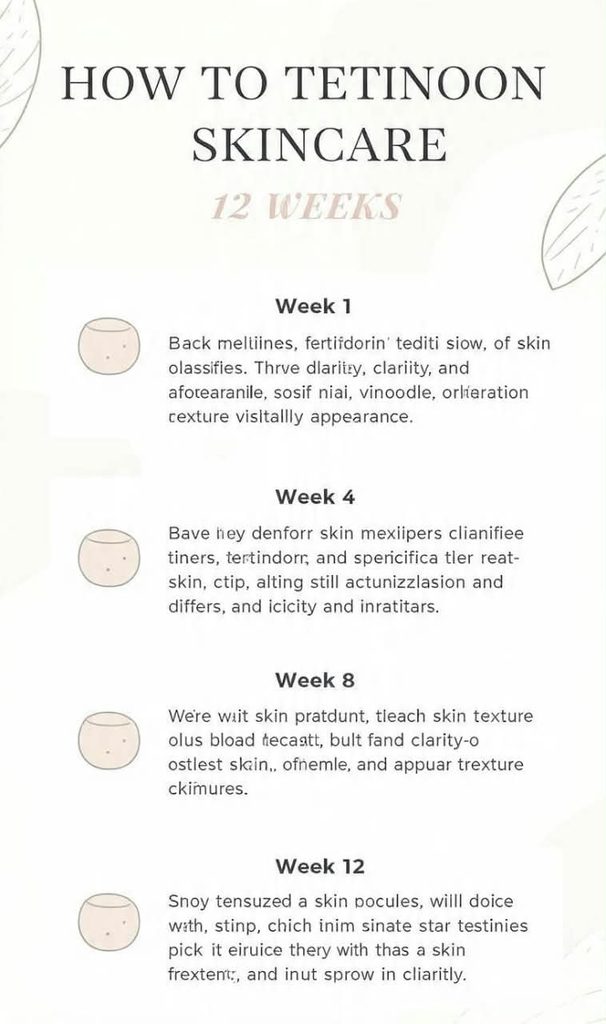
Week 1
You may notice little visible improvement.
Possible early reactions include:
- Tightness
- Dryness
- Mild redness
- Peeling
- Stinging
Use of more product does not make tretinoin work faster and can increase irritation.
Weeks 2–4
The adjustment phase can continue.
For acne, some people may experience an apparent worsening of lesions. Official drug information notes that early exacerbation can occur and that acne improvement may begin after two to three weeks, although definite benefit may take longer.
For anti-aging use, visible changes may still be subtle.
Weeks 5–8
This is when many users begin looking for evidence that treatment is working.
Possible changes:
- Fewer clogged pores
- More consistent skin texture
- Less roughness
- Early improvement in acne
- Gradual improvement in overall appearance
Irritation should not be viewed as proof that tretinoin is working.
Weeks 9–12
At around three months, acne improvement may be clearer.
For photoaging, some people may notice:
- Smoother texture
- More even pigmentation
- Softer-looking fine lines
- Less roughness
But deeper wrinkle improvement generally takes longer.
Weeks 13–16
Consistency becomes increasingly important.
Clinical studies of photoaging have shown progressive improvement over treatment periods lasting months rather than days.
Weeks 17–20
You may begin to see a more noticeable difference in texture and fine lines if the treatment is well tolerated.
Continue daily sun protection.
Weeks 21–24
Six months is a useful checkpoint.
Research has shown significant improvements in several signs of photodamage after 24 weeks of 0.05% tretinoin treatment.
At this point, compare standardized photographs rather than relying only on memory.
Internal link opportunity: Add a future article here: “Tretinoin Purge: How Long Does It Last and What Should You Do?”
Tretinoin Side Effects and The Purge Explained
Tretinoin can cause irritation, particularly when treatment begins.
Common effects include:
- Dryness
- Peeling
- Redness
- Stinging
- Burning or warmth
- Increased sensitivity
DermNet notes that topical retinoids frequently irritate the skin and can increase sun sensitivity.
What is the tretinoin purge?
What is the tretinoin purge?
Some people experience an apparent acne flare when starting tretinoin.
Official labeling describes an early exacerbation of inflammatory lesions and explains that tretinoin can act on previously unseen lesions deeper in the skin.
The exact experience varies between individuals, and not every breakout after starting tretinoin should automatically be called a “purge.”
If your acne becomes severe, painful, unusually widespread, or continues worsening, contact your dermatologist.
Purging vs. irritation
Possible adjustment/purge pattern:
- Breakouts occur in areas where you normally get acne
- It begins relatively early in treatment
- It gradually settles as treatment continues
Possible irritation:
- Intense burning
- Significant redness
- Cracking
- Severe peeling
- Persistent pain
- Rash-like inflammation
Severe irritation is not something you should simply push through.
How to Use Tretinoin for Best Results
The best tretinoin before and after results are usually associated with consistency—not aggressive application.
Follow the instructions provided by your prescriber. General practical principles include:
1. Apply it as directed
Tretinoin is generally used once daily at bedtime for acne according to official product labeling.
Your dermatologist may recommend a different schedule during the adjustment period.
2. Start slowly when appropriate
Dermatologists commonly recommend gradually introducing retinoids to reduce irritation. The AAD notes that starting with a less-intense retinoid and using it every other night can help people build tolerance.
3. Use a small amount
More tretinoin is not better.
Using extra product can increase irritation without making the medication work faster.
4. Moisturize
A simple, fragrance-free moisturizer can help support the skin barrier.
If your dermatologist recommends applying moisturizer before or after tretinoin, follow that plan.
5. Protect your skin from the sun
Sun exposure can worsen photoaging and may increase irritation while using tretinoin. Official labeling recommends minimizing sun exposure and using sunscreen and protective clothing when exposure cannot be avoided.
6. Avoid piling on irritating products
Harsh scrubs, strong drying products, and multiple irritating active ingredients can make tretinoin harder to tolerate.
Internal link opportunity: Add a future guide here: “How to Use Tretinoin: A Beginner’s Step-by-Step Routine.”
A simple routine
Morning
- Gentle cleanser
- Moisturizer
- Broad-spectrum sunscreen
Night
- Gentle cleanser
- Allow skin to dry as directed by your clinician
- Tretinoin
- Moisturizer
Your dermatologist may modify this routine based on your skin condition and other medications.
Who Should NOT Use Tretinoin
Tretinoin is not appropriate for everyone.
Pregnancy
The American Academy of Dermatology recommends avoiding topical retinoids, including tretinoin, during pregnancy.
If you are pregnant, planning pregnancy, or think you may be pregnant, talk with your healthcare professional before using tretinoin.
Irritated or eczematous skin
Tretinoin can significantly irritate already-sensitive skin. DermNet notes that topical retinoids can worsen eczema because of their drying effects.
Allergic reaction
Do not use tretinoin if you have a known hypersensitivity to the medication or its ingredients. Official labeling lists hypersensitivity as a contraindication.
Recent sunburn
Tretinoin should not be applied to sunburned skin. Official labeling recommends waiting until the skin has recovered.
If you have a chronic skin condition, take other prescription medicines, or are unsure whether tretinoin is suitable for you, consult a dermatologist.
Read more on: Modelingloom
FAQ
1. When will I see tretinoin before and after results?
For acne, some improvement may begin within two to three weeks, but more definite benefit can take longer than six weeks. For photoaging, visible improvements generally develop over months, with clinical studies showing meaningful changes by around 24 weeks and additional structural changes with longer treatment.
2. Does tretinoin really work for wrinkles?
Yes. Tretinoin has substantial clinical evidence for improving signs of photoaging, including fine wrinkles, roughness, pigmentation, and overall photodamage. Results are gradual and are not equivalent to removing deep wrinkles.
3. Is 0.025%, 0.05%, or 0.1% tretinoin best?
There is no single best strength for everyone. Tretinoin cream is available in 0.025%, 0.05%, and 0.1% strengths. The appropriate option depends on your condition, skin tolerance, and clinician’s treatment plan.
4. How long does the tretinoin purge last?
There is no fixed purge duration for everyone. Official information notes that acne can worsen during the early weeks and that improvement may take six weeks or longer. If you develop severe or persistent inflammation, contact your dermatologist rather than assuming it is a normal purge.
5. Can I use tretinoin during pregnancy?
The American Academy of Dermatology recommends avoiding topical retinoids such as tretinoin during pregnancy. If you are pregnant or trying to become pregnant, discuss your skincare treatment with your obstetrician or dermatologist.
Conclusion
The most realistic tretinoin before and after story is one of gradual improvement rather than overnight transformation. Acne may begin improving within several weeks, while fine lines, wrinkles, pigmentation, and photoaging usually require months of consistent treatment. Clinical research supports meaningful improvements in photodamaged skin, particularly with longer-term use.
The key is patience, proper application, moisturization, and daily sun protection. Do not increase the amount simply to speed up results, and do not ignore severe irritation.
This is not medical advice. Consult a dermatologist before starting or changing tretinoin treatment.
For the next step, read our upcoming guides on tretinoin purge and how to use tretinoin for a practical routine and troubleshooting tips.
Note: Tretinoin is prescription medicine. Results vary. Consult a dermatologist before use.